
Author Archive


Improving Your Video Cost To Quality Ratio

Improving Your Video Cost To Quality Ratio

Highlight any text in the blog to tweet or share on Facebook.

No doubt about it, video cost tends to be one of the most important factors people consider when they hire a production company. From our end we can present them with the best video idea ever, but a deciding question will always be… how much is this going to cost?

Like a lot of things, especially creative endeavors like video, the amount of money you spend can have a direct impact on the quality you receive. What I’d like to do is provide a way for you to improve your cost to quality ratio.

Video cost to quality… not savings

This doesn’t have to do with how-to save money. In this case, I’m working under the assumption that you have a video budget. It doesn’t matter whether you have $1,000 or $20,000. This tip is to make sure you get the most out of that budget.

Are you ready? Share that budget with the video companies that you’re considering.

I know, I know… there are a lot of people who are wringing their hands at that idea. We’re supposed to keep that information close to the vest. You never know, you might plan for a big budget then get a proposal back that’s half that.

Well, in my experience, that’s unlikely to happen with video. As a matter of fact, most people underestimate what their video is going to cost. It’s not because video production costs a ton, it usually has more to do with people not knowing how-to figure out video production cost.

The big thing to keep in mind is that there are all sorts of variables when it comes to pricing a video project:

  • How much time will it take to shoot?
  • What sort of personnel will be needed?
  • What equipment will be used?

A video could range in cost by several thousands of dollars depending on those answers. When you don’t share your budget, you leave the video company guessing. In many cases, they might put together an awesome proposal for you that costs way too much. That’s a bad situation for a couple of reasons.

First, it’s a waste of your time. After you get a proposal and tell the production company it’s over your budget, you now have to wait for them to produce another proposal.

Second, and maybe worse, you might just pass over your favorite company and go with someone else you’re less enthused about because you think your favorite is simply too expensive. However, if you had shared your budget, they may have adjusted their resources and still come up with a killer idea that cost less than the proposal that was “too expensive.”

ARVE Error: id and provider shortcodes attributes are mandatory for old shortcodes. It is recommended to switch to new shortcodes that need only url

Why you should share your budget

The main reason sharing your budget is a good idea is because it’s going to ensure you get your money’s worth. Here’s how to do it when you start shopping around for a production company:

  • Inform each company about your budget.
  • Tell them you’re getting proposals from three companies and you’d like to know what they can do for that budget.
  • You may consider telling them they’ll get bonus points if they have some great ideas that come in under budget, but I’m guessing that won’t even be necessary. I’ll get to that later.

When you tell them these things, here’s what’s going to happen at those video companies. First, remember those important variables I mentioned for pricing a video project? Having a budget figure in-mind means they can start to answer those questions accurately.

They might love the idea of a 2-3 camera shoot, using a quadcopter to get aerials, and making sure there is a field producer who accompanies the videographer(s) on the shoot. However, your budget might only support the cost of two of those three things… or just one… or none for that matter. The point is they’ll be able to produce a proposal that fits your project.

How it works

Here’s where you get the most for your money. You’re going to be getting proposals from multiple companies. I assure you… they will look very different from one another. Some companies are heavy on technical ability, while others are more focused on storytelling. In either case, you’ll have a much better idea of what you’ll be getting for your money. So while you might not be saving money, you’ll be able to pick a proposal where you get the most for your money… or at least those things that are most important to you.

Also, notice I wrote you “might” not be saving money? Well, a funny thing happens when you tell people they’re in competition for your business. Not only will they try to give you as much as they can within the proposal for your budget, they might even give you a lower-cost option. In some cases, they might be able to produce a video that will help you achieve your marketing goal for a lower cost. The competition you set-up is their incentive for trying to come in under budget. In many cases, you won’t even have to suggest this. They’ll just do it on their own in an effort to earn your business.

I’m not good at sharing

Having gone over all of that, I totally understand that some people just won’t want to share their budget… especially if it’s a big figure. So here’s my last piece of advice. If your budget is $10,000+ for a single video, by all means keep it to yourself. Ten grand is a substantial budget. On the other hand, if you’re producing a video for less than that, go ahead and share your budget. The process will go much smoother for you and your production company partners.

–Tony Gnau

 

How Storytelling Sold My Beat-up Mazda

How Storytelling Sold My Beat-up Mazda

Highlight any text or photo to tweet or post to Facebook.

Storytelling is something I strongly believe in, and I’ve written about how it’s more than just a buzz word. Well, I recently put storytelling to the test and it didn’t disappoint me.

Mrs. G and I recently sold our car… a 2002 Mazda Protegé. It is… a working automobile. The car isn’t a hunk of junk or anything. The interior looks nice. It runs great. We took really good care of the engine, but it does have its fair share of dings, scratches, and rust. It’s not exactly the type of car that jumps out at you and says, “Look how awesome I am. You know you want to buy me.”

Avoiding the classic corporate video mistake

As a video producer, it should come as no surprise that I decided to create a video to help us sell the car. I started thinking about car videos I’ve seen in the past, and I decided right away I was going to go in a different direction.

Most sales videos for cars make the same mistake a lot of corporate videos do. They focus on facts and figures. Car videos list off things like the number of miles on it, horsepower, 0-60 times… heck… even how many cup holders are inside. Do you think any of the facts and figures about our beat-up Mazda Protegé would wow people into wanting to buy it? Me neither.

Video isn’t about the facts, ma’am

ARVE Error: id and provider shortcodes attributes are mandatory for old shortcodes. It is recommended to switch to new shortcodes that need only url

It’s a good thing then that video isn’t about facts. It’s about emotion. Videos should tap into viewers’ emotions and storytelling is a great way to do it.

The goal I have for most of the videos we produce at T60 is simple. We want viewers to walk away from each video feeling good about the company featured in the story. We want them to feel confident in that company’s ability to do the job… whatever that job might be. However, in the case of the Protegé video, I decided to tug at heartstrings.

I’m not going to tell you the story here. You’re better off watching the finished video for yourself. The behind the scenes scoop on the story is that I’ve wanted a new car for years, and I had been plotting to get rid of the Protegé as soon as I could. Only… when the time finally came… I felt very sentimental about the car. That sentimental feeling is what inspired the whole video.

Storytelling is only the first step

Of course, producing the video is just the first step in the marketing process. The next thing I had to do was to promote it. Of course, I posted it to YouTube. Mrs. G and I used Facebook to send the video to all of our friends and family. and I posted it on Google+.

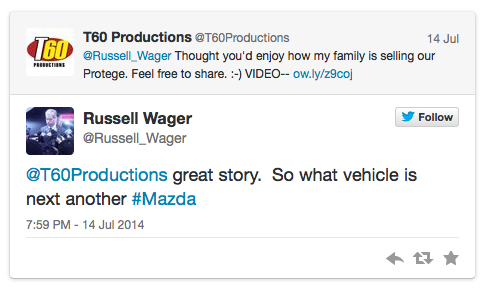
mazda cmo tweetI also targeted influencers. I sent a tweet to Mazda’s Chief Marketing Officer, Russell Wagner, but the one that ultimately made the difference was… our mechanic.

That’s right, I sent the video to our mechanic. It’s a good lesson in who influencers can be. They don’t have to be a bigwig. It would have been great if Russell Wagner had retweeted the link to my video, but our mechanic has influence as well. I figured he’s tied into the local automotive community. Why not tell him?

It was a smart move because guess who bought the car? He did. A week or two after I contacted him, he called me to see if it was still for sale. Turned out he wanted to buy a car for his girlfriend, so he shared the video with her… and that’s all it took. She was sold… and so was our car.

That’s the power of video. That’s the power of storytelling.

–Tony Gnau

Top 3 Tips For Making A Crisis Management Video

Top 3 Tips For Making A Crisis Management Video

Highlight any text in the post to tweet or share it on Facebook.

Nobody likes a corporate crisis. Okay, maybe the media enjoys them, but if you work at a company facing a very public corporate crisis you’re probably not a fan. I mean, it’s the type of thing that can sink a company, and your job along with it. Which is why in a crisis situation, your business might need a crisis management video.

Now, I’m not going to advocate producing a video for every crisis that comes down the pike. It’s not a cure-all. However, a well-done video can turn the situation around and do it quickly.

The reason it’s so effective is that video allows you to go beyond words. Sometimes in a crisis there’s no better way to dispel a charge than by showing people the truth.

Ronald McDonald is on the case

One of my favorite cases of this is the way McDonald’s Canada handled the big question about Chicken McNuggets. You know… what are they made of anyway? Instead of letting rumors about pink goop persist, McDonald’s Canada took people behind the scenes with a video showing the whole process of how McNuggets are made.

Over 4-million views later, do you think McDonald’s executives are happy they produced that video? I should think so. McDonald’s haters will surely find some fault in it, but the general public? I think the video is probably very reassuring.

In that case, the video allowed McDonald’s a chance to get out in front of a potential crisis.  Video can do the same thing for a company in the midst of a crisis.

Well-played Domino’s

After Domino’s employees posted some disgusting pizza videos on YouTube, the president of the company responded with his own video apologizing for their behavior. This is impressive on a couple of levels.

First, he made his apology using the same medium the pranksters used. When someone watched the “bad” videos, his video popped-up right along side of them thanks to the way YouTube tags and searches work. Second, he puts emotion behind the corporate response. It’s one thing for the public to read an apology on a page or computer screen. It has so much more impact when it’s read aloud to them.

I would have preferred to hear him speak from the heart instead of reading the message that was presumably screened by Domino’s attorneys, but it was still a good effort.

3 Tips for your crisis management video

So… here are some tips for creating your own crisis management video.

  1. Be honest.
  2. Be sincere.
  3. Be honest.

I could go into detail about production tips… highly produced versus minimally produced… music bed versus no music bed… scripted versus non-scripted, but in the end it all comes down to honesty and sincerity.

People can see right through a lie. They can tell when someone is being insincere. So… just be honest. Because while a truthful and sincere crisis management video can help you win back hearts and minds, an insincere video can do the opposite. It can make a crisis even worse.

Be honest, show people how you really feel, and you’ll be on your way to crisis recovery.

–Tony Gnau

Answering our frequently asked questions

Helpful Video Marketing Blog Posts

If you’re going to produce a PR or marketing video, you probably have a bunch of questions.

Thankfully, we have answers.

Even better… we’ve probably already written about them. Which is why we’re providing this list of helpful video marketing blog posts.

Video Production Cost and Budgeting

How to Pick a Video Production Company

FYI… either one of these are helpful for selecting companies in Illinois, Wisconsin, or anywhere else for that matter!

Just Getting Started?

Different Types of Videos

Why Marketing Videos Work

Did we miss something you’re interested in? First, type some keywords into the “search” box in the right column of our blog. We’ve written over 700 blog posts, so you might find what you’re looking for there.

Don’t want to search and rather get straight to the point? No problem… get in touch.

–Tony Gnau

Experts Pick 5 “About Us” Video Mistakes

Experts Pick 5 "About Us" Video Mistakes

Highlight any text in the post to Tweet or share on Facebook

More and more business leaders are embracing the power of video and that’s great. The big question for many is where to start? My advice is to begin with the one video every company should have at their website… the “About Us” video.

It seems simple enough, and I have given advice in the past on how-to create a great “About Us” video. Unfortunately, many businesses still produce videos that miss the mark, so why not learn from other company’s pitfalls?

Thankfully, we know some business, marketing, and public relations experts willing to help guide you past the “About Us” video mistakes they’ve seen.

gini dietrichGini Dietrich CEO, Arment Dietrich | Founder, Spin Sucks the Blog (PR Readers’ Choice Award-Top PR Blog) | Author or Spin Sucks the Book | @ginidietrich

I have a saying, which is to take the French (the we, we, we) out of all of your website content. Most “About Us” videos are, well, all about the organization and don’t put the customer in the shoes of what it would be like to work with this particular group of people. Use your “About Us” video to tell a story that matters to your customers.

Andy CrestodinaAndy Crestodina – Strategic Director, Orbit Media Studios (web design and development firm) | Author of Content Chemistry: The Illustrated Handbook for Content Marketing | @crestodina 

These videos are so powerful, especially when they get right to the point. And the point is your passion. They need to explain why you do what you do. The text on your website let’s visitors KNOW something. But this video let’s visitors FEEL something. Keep. It. Real.

A common mistake is to bury it. An “About Us” video doesn’t need to go on your “About Us” page. It’s often effective to put it right on the home page. The most prominent home page message is WHAT you do. But WHY you do it (explained in a compelling video) should be right there next to it.

Danny BrownDanny Brown – Danny Brown Blog (#1 ranked marketing blog by HubSpot) | Co-Author of Influence Marketing | @DannyBrown

I’d say the biggest “mistake” is focusing on the leads. Yes, it’s great to see who the strategic players are – but how about a friendlier, “This is Mary, she keeps us informed on why we’ll never understand the appeal of SnapChat”, etc? Make the video fun, involving, self-deprecating. Unless you truly need to make a boring corporate video, stand out from the others and make it a real “About US” video.

Jil SalzmanJill Salzman – Founder, Founding Moms (Forbes Top 10 Websites for Women Entrepreneurs) | @foundingmom

Some video mistakes I’ve both made and seen:

Taking too long to get your message across really hurts your video and your brand. Strong editing is always a plus, especially in the day and age of no-attention-span video viewers.

You have to tell a story. If there’s no story, you can’t captivate the audience. I stand by the fact that you have to give your viewer the why. Tell them why they should be paying attention to your video by way of a story in said video and you’ll capture both their attention and their imagination, and eventually, their loyalty and purchase power.

Darcy SchullerDarcy Schuller – President, Suvonni | Board President, ChicagoAMA (Chicago Chapter of the American Marketing Association) | @darcyschuller

Too Long!  A well produced video should give the viewer just enough information that they need while keeping them engaged. Too many times I’ve seen “About Us” videos that give a complete history of the organization, what they do, why they do it, who they do it for, etc. that ends up being way too long for the bite-size tolerance of most people today. Brevity shouldn’t be undervalued.

Low Quality.  Lighting, sound and visual elements (whether it’s images, video, or animation) need to portray the same quality that your business stands for.  It doesn’t necessarily need to be perfect, but it does need to be high quality. A poorly produced video is worse than no video at all. If you are going to take the time and effort to create a video, make sure you do it right.

Okay… we actually had more than five mistakes there. Five experts gave us EIGHT mistakes. Yup… you got three bonus mistakes to avoid!

So… do you have any mistakes to add?

–Tony Gnau

PR and Marketing Pros Guide To Video

PR and Marketing Pros Guide To VideoIf you’re a marketing or public relations professional, you know the value of video. You know how it can help a business communicate. You know how storytelling can help a company sell. It’s a fun and creative process that can deliver big time for a business… but there’s definitely some things to know in advance of starting. This blog post should serve a handy guide to video for both you and your clients.

Budget

First thing you need to do is to plan how much you’re going to spend on the project. That is… unless you have unlimited funds! Yeah… right.

Budget is important for one big reason. It will dictate the type of video you can produce.

A big budget means being able to hire professional storytellers, bringing in all sorts of fancy equipment, and the personnel needed to run everything. The more your budget drops, more decisions you’ll need to make about what to prioritize.

Don’t get me wrong, more money doesn’t always equal better results. Not all dollars are equal. Sometimes the difference between a $6,000 video and a $20,000 video can be minor. However, the difference between a $500 video and a $6,000 video can be huge. The trick for you will be finding the right balance within your budget.

I recommend that you contact a few video companies early in the decision making process. Ask for a ballpark quote. They should be able to help guide you and let you know how to figure out production costs.

Picking a producer

There are all sorts of business leaders out there who are attempting to produce DIY corporate videos. Ugg. Here’s the deal. I love video. I love when a company wants to produce videos. I am not a fan of amateur productions for businesses. Here’s why.

The company’s video is potentially going to be seen by a lot of people. Hundreds? Thousands? In some cases, millions? It all comes down to reputation.

Business leaders won’t bat an eyelash at spending thousands of dollars on business cards for employees. An item that more times than not, will end up in the trash. Why? Reputation. A good quality business cards project something about a company. So why would they then choose to produce a video that could look unprofessional and potentially damage that reputation?

If you’re a start-up with no money, by all means produce your own video. If you’re a mom and pop shop with no marketing budget, grab your iPhone and shoot away. But if you work for a quality small, medium, or big business… hire a video professional.

[tweetthis]Work for a quality company? Don’t DIY a company video. Hire a video pro. Your reputation is on the line.[/tweetthis]

Need some help on what to look for in a good producer? These are some thoughts on how to pick a video company.

Concept planning

You might have an idea of what type of video you’d like to produce, but when it comes to brainstorming I suggest that you wait on the heavy-lifting until you start the process of hiring your video pro.

Tell them what you’re hoping for. Maybe give them some rough thoughts, and then let them run wild with their own ideas. It’s a smart thing to do for a few reasons.

  • Video pros will have a realistic idea of what they can accomplish and how much it will cost you.
  • They’re producing videos all the time so they know what types of videos have been successful in connecting with audiences in the past.
  • It gets their creative juices flowing and makes them excited about the project. Executing an existing plan is fine, but it’s a lot more fun for them if they get to work on an idea they helped develop and are passionate about. An engaged producer means you’re going to get their best effort and a better video.

Once you’ve decided who you’d like to hire, continue to talk with them about the project. Be sure to duscuss how this video is going to work with your overall marketing plan.

I’m not a fan of scripting things in advance, but if that’s your thing… this is when you’ll start working on it.

Pre-production

There are all sorts of variables before you start to shoot any video. Here are some things you’ll want to make sure you have squared-away… whether it’s your video producer who’s handling it or whether you’ve decided to help.

  • Make sure you schedule when and where the video will be shot. Make sure the appropriate people at the location know you’re going to be shooting video on that date.
  • Contact anyone who needs to be at the shoot. Make sure they’re aware of when and where they’ll be needed.
  • Coordinate with the video crew. Give them all the scheduling details, contact names, and addresses for where they’ll be shooting.

Remember, communication is a wonderful thing. The more everyone is on the same page, the easier the production will run.

The shoot

Believe it or not, this is the easy part and when the real fun begins. If you’ve done a good job with the concept planning and the pre-production, you should be able to sit back and simply let your video pros do their job.

By all means, keep a close eye to make sure everything is being done properly, but there shouldn’t be any reason to micromanage. Chances are your video team is cranking on all cylinders.

Also, keep in mind this is a creative venture you’re now on, and sometimes things might not go as planned. Lean on your producer to comes up with creative solutions. Sometimes some of the best production elements come from improvisation on the day of the shoot. It’s part of the fun.

Post-production

This is when the project really starts to come together. Your video pros are likely combing over all of the raw material. They’ll probably provide you with a more detailed script. Then the video editing begins.

Take a look at the finished product. Try not to watch it as an insider. Watch it through your audience’s eyes. Talk with your producers about anything that needs to be tweaked.

Promotion

Alright, the editing is complete. You have the digital file. But honestly, your work has just begun.

That video isn’t going to do the company any good until you get it out into the world and let people know about it. Make sure your client understands that people will not miraculously find their video. If you or they need some specific ideas for how to do it, check out these seven ways to promote your video.

–Tony Gnau

Picking The Right Music For Your Videos

Picking The Right Music For Your VideoOne of the biggest production mistakes you can make is picking the wrong music for your videos. From the type of music to the mood it might elicit, there are all sorts of things that need to be considered when selecting a song… no matter what type of video you’re producing.

Is music even necessary?

First thing’s first, and it’s something many people don’t consider at all. Does the video even need music. That’s right. Not every video must have a music bed.

The main reason to use music is to set a mood. If you’re really focused on the content and less about mood, you might not want any music.

Next, if you have decided to move forward and use music, there are some things to consider.

The right music taps emotion

You can use music to manipulate the way people feel about what they’re watching. I don’t mean that in a sinister way. Just that your choice of song will tap into viewers’ emotions.

Pick an upbeat and happy song and you’ve put people on the path to feeling the same way about your content. Select a song that’s serious and sobering and viewers will expect that from your video.

Think about your subject matter and the way you want people to feel about it. That can help guide you when you’re looking for the right music.

Consider your viewers

Another consideration is the audience. Think about them and the type of music that’s going to catch their attention. The music you select for an older audience should be different than the music you select for a younger audience. There could be a difference in what you pick depending on whether your target audience is mostly men or women.

The main thing to avoid is simply picking the music that appeals to you. Think about your audience and their needs before your own.

Don’t pick this type of music for your videos

Speaking of things to avoid, here’s probably the biggest one… popular music. Many people like to incorporate popular music into their videos, but I’m not a fan and there are a couple reasons why.

  • You don’t own the rights. The song might be “perfect” for your video, but you can’t just pick any song you like. You have to have the rights to use it. Now, you can often buy the rights, but that’s an expensive proposition when it comes to popular music.
  • Popular music is too close to people’s hearts. Even if you didn’t have to worry about rights, music makes a strong impression on people. If you choose a song they’re familiar with, they’ll likely stop processing what they’re seeing in your video and start thinking about that song. I hate that song… I love that song… I remember where I was the first time I heard that song. These are all things they might be thinking about instead of paying attention to your content.

Bottom line, stick to royalty-free music from sites like premieumbeat.com (my personal favorite) or even the free music you can get from YouTube’s audio library.

Wrapping it all up

I love what music can do for a production. It can take mediocre content and make it more appealing. It can take good material and make it great. Finally, the right music can take great content and make it something that connects with an audience on a personal level.

So… don’t make it an afterthought. Keep it in mind through the production process. Make sure you select the right song for your video.

–Tony Gnau

Authentic PR Message Surprise

Image Courtesy: spinsucks.com

Courtesy: spinsucks.com

I’ve learned a lot about public relations from reading Spin Sucks, both the blog and the book. One of the lessons that has come through loud and clear is how important it is to deliver an authentic PR message. Which is why a recent phone call from Gini Dietrich was so surprising.

First thing’s first. I don’t work for a PR agency. I’m not even in PR, although in a way I am. I’m a video producer. I get called when PR agents need video storytelling for their clients. Gini is the CEO of Arment Dietrich and the founder of Spin Sucks. I met her about 4-years ago and T60 has been doing work for her, her company, and its clients for the last two years.

Gini and I have talked over coffee, we’ve gotten lunch together, but Gini makes her living in a digital world. She’s an expert in all things digital PR and marketing. She converted her whole business model into one with employees working through cyber space in cities all over North America and most of our communication is via email and tweets.

My Big Surprise

So… you can imagine my surprise when my phone rang and the name “Gini Dietrich” popped-up. I knew something important must be going on.

“Hey, are you free late this afternoon?” asked Gini.

“Actually, yeah. You caught me on a light day, what’s up?” I replied.

“Would you be able to bring your video gear and meet me someplace. I have a big event going on and I need bodies. I don’t have time to explain, but I think you’ll enjoy it.”

Intrigued… I agreed and she gave me a time and an address.

I arrived later that day at the address specified, a high-rise office building on North Michigan Avenue, Chicago’s Magnificent Mile. I took the elevator up and when the doors opened, I was blown away.

I was in a luxurious reception area with the name “Arment Dietrich” adoring the wall. I checked-in with the receptionist. The place was buzzing. Tons of people walking around the huge space, in and out of offices, cubicles, and conference rooms. Awesome video displays were everywhere displaying what looked like analytics.

After a few minutes, I was shown back to Gini’s corner office with a view overlooking the Chicago river and the historic Wrigley Building. Amazing. Gini greeted me and asked me to sit down… and I needed to.

“So… what do you think!?” she asked.

“Umm, where am I? Who are you and what have you done with Gini Dietrich?”

“I know… crazy, right!? You want to know the most amazing part? It isn’t real.”

Gini went on to tell me about a huge client she was trying to land. The only problem is that they tend to work with equally large PR agencies. She was worried they’d be freaked-out about potentially working with a completely digital agency with no corporate headquarters or central meeting space where busy team members go to work everyday.

Enter the fictional Arment Dietrich office. She was going to host a meeting in this place with the clients to give them a sense of comfort that her agency was big enough for them. She wanted me to play the roll of the head of Arment Dietrich’s video team.

It seemed so out of character for her, but whether it was the dizzying motion of the busy “employees” or the aroma of fresh coffee being made by the barista at the coffee station… I agreed.

ARVE Error: id and provider shortcodes attributes are mandatory for old shortcodes. It is recommended to switch to new shortcodes that need only url

The Clients Arrive

When it came time for the meeting, I really didn’t have much to do. Gini introduced me to the clients and I simply said hello and welcomed them to Chicago. That was it.

I watched the meeting as it took place in the glassed-in conference room and it seemed to go well. As it was going-on, I noticed all of the fake team members started filing out. By the time the meeting ended and Gini exited with the clients, I was the only one in massive office space.

The client was saying, “Gini, you have an amazing operation. Everything you shared about what you’re doing for your clients, all the data to back it up, it’s just what we need.”

“So you’re confident we can do the job?” said Gini.

“Yes. Your team is amazing,” said the client.

“And no more spinning? I know it’s been a big part of how you’ve done things in the past,” said Gini.

“Well, we might need some more convincing on that front, but we’re willing to listen.”

“Okay then… here’s your first lesson,” said Gini.

She went on to tell them about the whole ruse. The clients were furious.

“Good,” said Gini. “I’m glad you’re upset. You should be and you know why? Because spin sucks.

She went on to tell them that spinning might work in the short term, but eventually they’ll be exposed. And the feeling they were having right then about what just happened is the feeling their clients and prospects will feel about them when that day comes.

And that’s when I woke-up. I looked at the clock. It was 5:30 a.m.

Authentic PR Takeaway

What does this have to do with video production? Everything. A unauthentic PR or marketing video isn’t any better than the whole scenario I dreamed about. It’s fake. It’s phony. It’s spin.

Be authentic. Be truthful. Show your customers and prospects behind the curtain. Audiences respond to honesty. It helps build a connection between them and your company.

Your videos don’t need to highlight a perfect company… just a real one with real people behind it.

–Tony Gnau

Flag For Content Marketers This 4th Of July

Taking a little summer break from blogging this week, but with the 4th of July just days away… a special treat.

You know how anyone involved in content marking is supposed create super-helpful content? Well, this is information every American should have for this special occasion. We didn’t produce it… but we wish we had. :-)

Happy Independence Day!

–Tony Gnau

How-to Make a Bacon American Flag

How-To Help Tell Your Company’s Story

ARVE Error: id and provider shortcodes attributes are mandatory for old shortcodes. It is recommended to switch to new shortcodes that need only url

This month’s vlog focuses on an important topic. How-to help tell your company’s story.

It probably sounds so simple. As a matter of fact, you may have told people about your company or job a million times. But are you telling an effective story? Are you telling a story that resonates with people? That will keep their attention? That will endear them to you and what you do?

See… there’s more to it than you think. In the vlog, I give you an example of how your story can be found right under your nose, or in this case on a bookcase, as well as a good way to get started.

–Tony Gnau